Published
The ACSI Insurance Study 2026 finds weaker satisfaction with health and life insurers, while property and casualty customers report improvements in claims speed and personal service. Insurance companies have invested heavily in digital tools and automation. Their customers, however, are not consistently reporting a better experience.
The American Customer Satisfaction Index’s Insurance Study 2026, released October 27, finds that health insurance satisfaction fell from 76 to 75, while life insurance declined from 78 to 77. Property and casualty insurance held steady at 76.
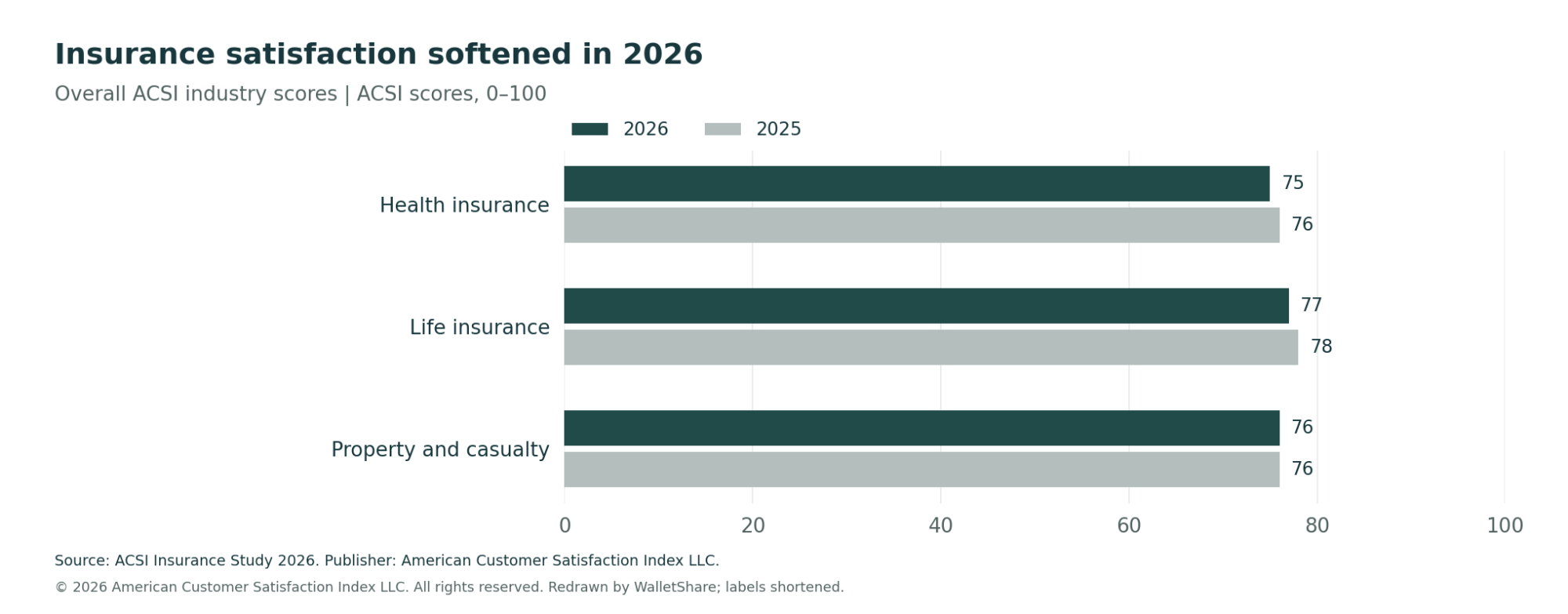
Those modest industry movements conceal larger differences between companies and between the parts of insurance service that customers encounter.
Scores use a 0–100 index scale. They are not the percentage of customers who are satisfied. Source: ACSI Insurance Study 2026, American Customer Satisfaction Index LLC.
Health Insurance: Reliable Apps, but Uneven Service
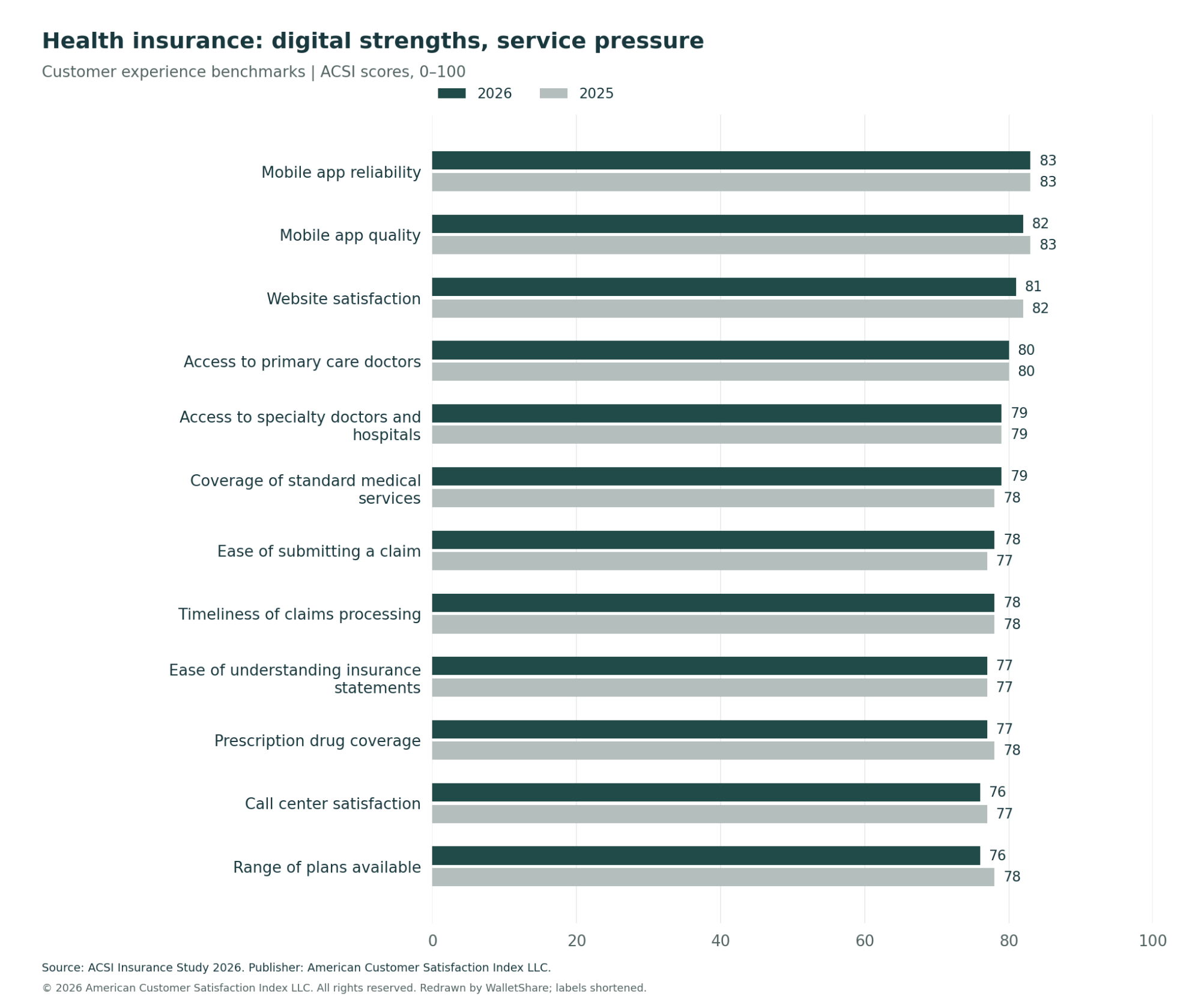
Health insurers’ digital platforms remain among their strongest customer-experience measures. Mobile app reliability scored 83, unchanged from 2025. App quality and website satisfaction remained relatively high, at 82 and 81, respectively, although both declined by one point.
Other measures were less encouraging. Call center satisfaction slipped from 77 to 76, prescription drug coverage declined from 78 to 77, and the range of plans available fell from 78 to 76.
There were improvements: ease of submitting a claim rose from 77 to 78, and coverage of standard medical services increased from 78 to 79. Timeliness of claims processing remained at 78.
Humana led the named health insurers for the fifth consecutive year, scoring 78, followed by Kaiser Permanente at 77. UnitedHealthcare fell three points, from 77 to 74, while Centene declined from 75 to 73, the lowest company score in this category.
The results suggest that dependable technology does not, by itself, resolve concerns about coverage choices or access to assistance. They do not establish that any particular technology investment caused satisfaction to rise or fall.
Life Insurance: Personal Attention Holds Up Better Than Digital Tools
Life insurance recorded its third consecutive annual decline in overall satisfaction. The customer-experience measures show several areas of weakness.
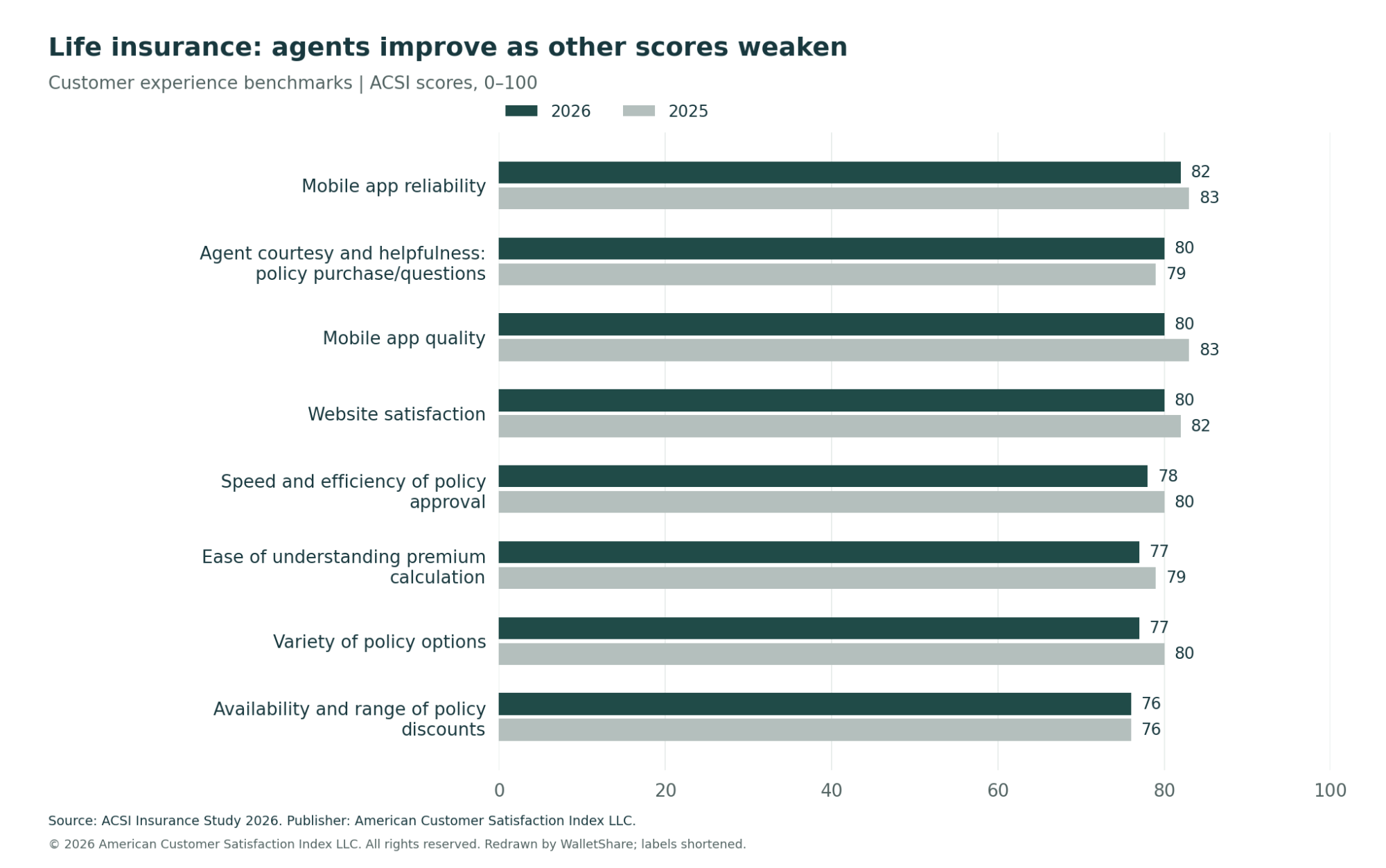
Mobile app quality fell from 83 to 80, website satisfaction declined from 82 to 80, and the variety of policy options dropped from 80 to 77. Customers also gave lower scores to the speed and efficiency of policy approval and the ease of understanding premium calculations.
Agent courtesy and helpfulness provided the exception, improving from 79 to 80 the only life insurance benchmark to increase.
Mutual of Omaha became the industry leader at 81, up from 80. State Farm followed at 79. New York Life and Prudential each declined two points to 78, while AIG fell three points to 74.
Primerica, returning to the study, scored 71, the lowest among reported life insurers. Because its table entry has no 2025 comparison, that result should not be described as an annual decline.
For an insurance product that can involve long commitments and complex choices, the relative strength of agent interactions is noteworthy. Customers appear to value helpful personal contact even as other parts of their experience weaken.
Property and Casualty: Better Claims Service, Different Company Results
Property and casualty insurance presents a more encouraging service picture, despite its unchanged overall score.
Customer ratings improved for several practical interactions:
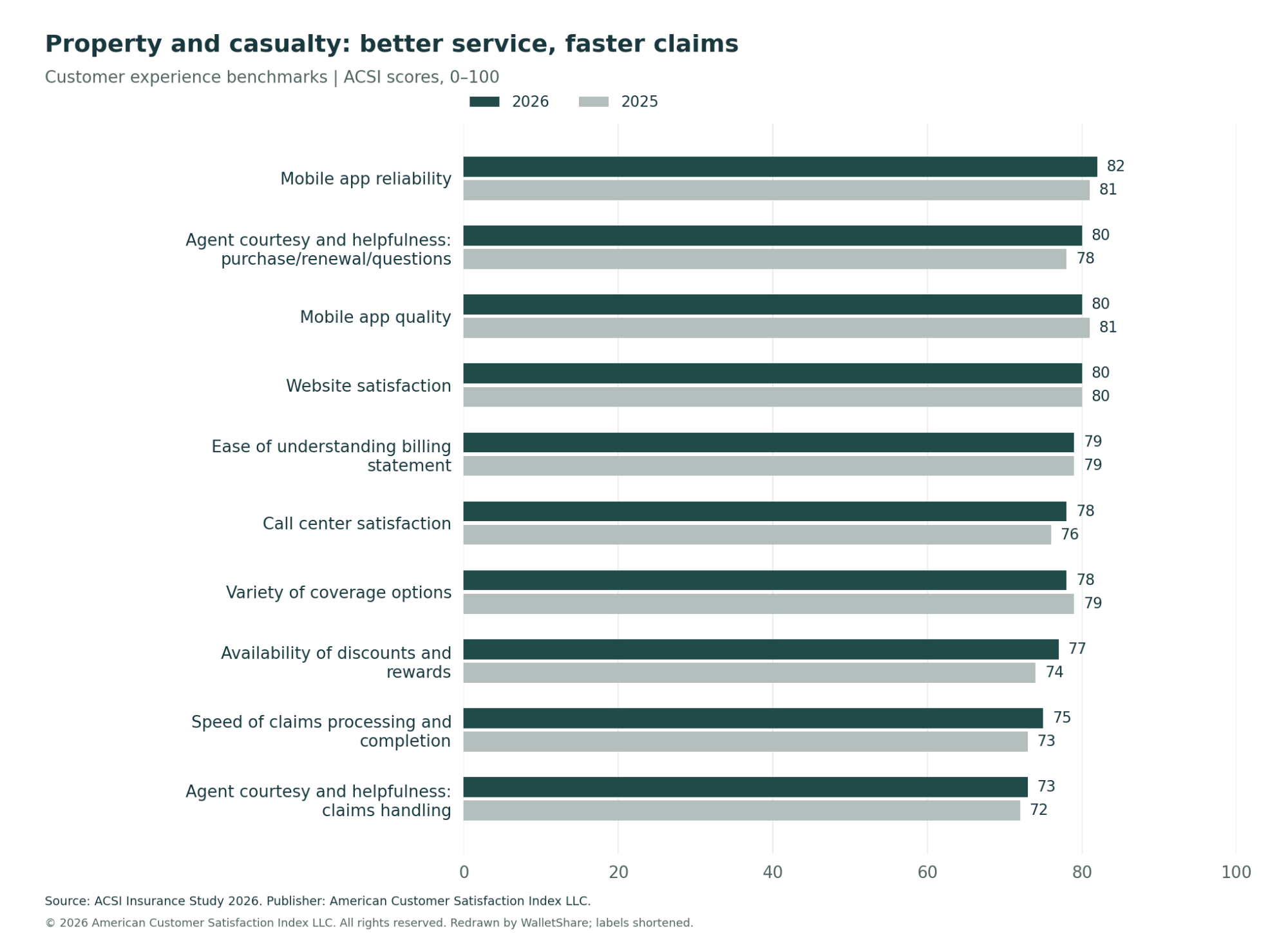
- Call center satisfaction: 76 to 78.
- Claims processing speed: 73 to 75.
- Agent courtesy and helpfulness for policy questions: 78 to 80.
- Availability of discounts and rewards: 74 to 77.
Mobile app reliability also increased, from 81 to 82, although app quality slipped from 81 to 80.
The stable industry average masks substantial company movement. State Farm rose from 79 to 81, taking the lead. Allstate increased to 78, while Geico improved from 75 to 77.
USAA moved in the opposite direction, falling from 85 to 77, an eight-point decline, reported by ACSI as approximately 9 percent. USAA serves eligible military-affiliated individuals and families.
Chubb, returning to the study, scored 65, producing a 16-point gap between the highest- and lowest-scoring companies. Its table likewise provides no 2025 score for an annual comparison.
What the Findings Mean for Policyholders
The strongest pattern is the importance of getting useful help when an insurance question or claim arises. Apps generally score well, but improvements in personal service stand out in life insurance and property and casualty coverage.
The study also shows why industry averages can be misleading. An unchanged overall score does not mean every company, or every part of the customer experience, stood still.
These results provide context when comparing insurers, but they do not measure every policy’s coverage, price, or suitability. Nor are the scores measures of insurer financial strength or the probability that a particular claim will be paid.
For consumers, satisfaction ratings are most informative alongside the details of their own policy: what is covered, what is excluded, how claims are handled, and what assistance is available when something goes wrong.
About the Study
The ACSI Insurance Study 2026 draws on 14,155 completed surveys. Customers were selected at random and contacted by email between October 2025 and September 2026. The study covers major insurers and an aggregate category of smaller companies.
ACSI scores are modeled indexes on a 0–100 scale. Changes discussed here are index-point changes unless explicitly labeled as percentages. The report does not provide company-level confidence intervals, so small differences should not be treated as proof that one insurer will deliver a better experience for every customer.
Source: ACSI Insurance Study 2026. Publisher: American Customer Satisfaction Index LLC. © 2026 American Customer Satisfaction Index LLC. All rights reserved. Charts redrawn by WalletShare from the report’s published values; some labels shortened.