Published
A new report from Vanguard, 'How America Retires 2026', explores what happens after the saving years, when investment balances must support everyday life. For much of a working career, retirement planning centers on a familiar question: Am I saving enough? At retirement, the question changes. How should those savings become income, and how can that income last for an uncertain number of years?
That transition is the central theme of Vanguard's report. Drawing on retirement plan records and related research, the report examines how retirees manage investments, access their accounts, and weigh decisions about income, taxes, healthcare, and longevity.
Its broad message is that building a retirement balance and knowing how to use it are different challenges.
Saving Has Become More Automatic. Spending Remains Personal.
Automatic enrollment, rising contributions, and diversified default investments have helped simplify workplace saving. Vanguard reports that its 2025 plan data showed record participation and contribution measures.
There is no equally simple default for retirement spending. Two households with similar account balances can have very different needs because of pensions, Social Security, debt, health, family obligations, and desired lifestyles.
That is why the report emphasizes a personalized income plan rather than a single withdrawal formula for everyone.
A Long Retirement Changes the Calculation
One of the report’s most important points is that longevity deserves as much attention as investment performance.
A retirement lasting 20 years presents a different funding challenge from one lasting 30 years or more. Even reasonable market returns may not support a spending plan indefinitely.
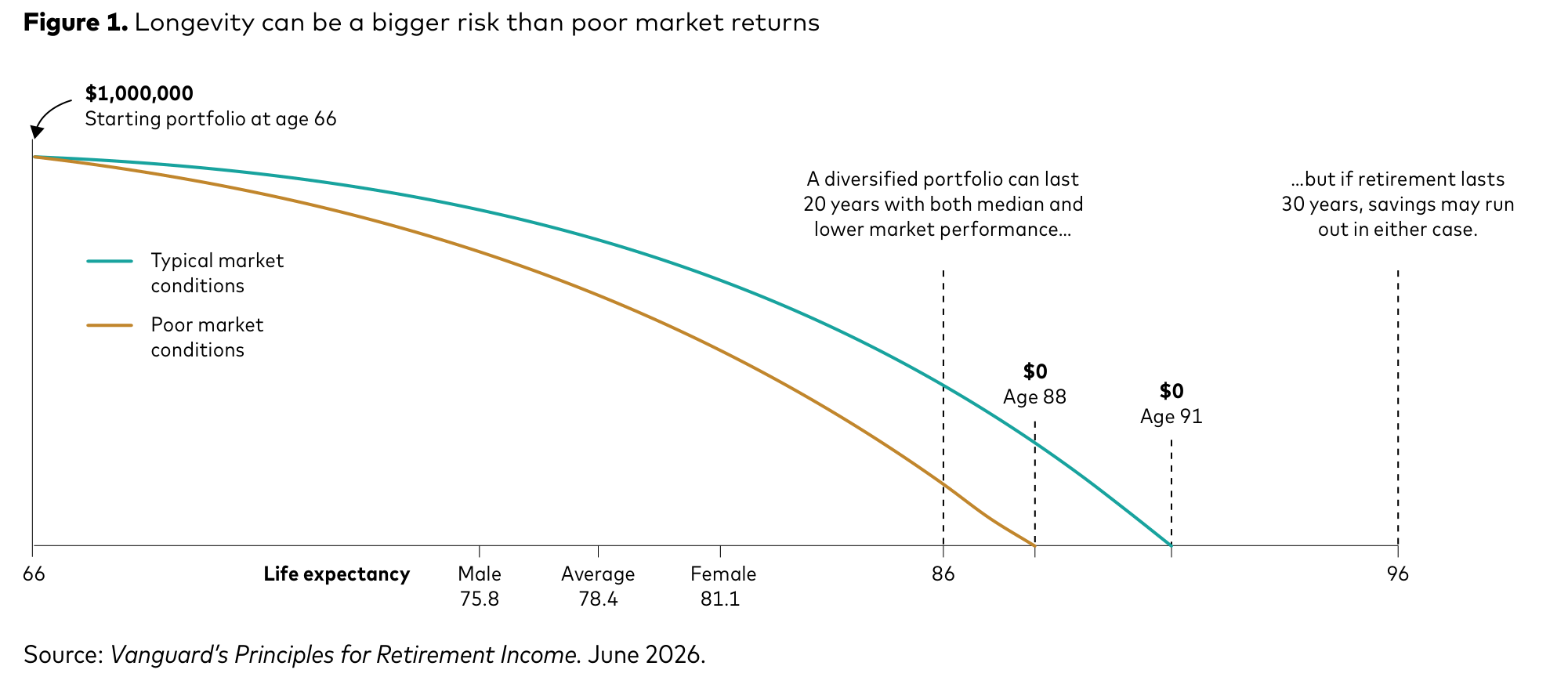
Source: Vanguard, How America Retires 2026, Figure 1, citing Vanguard’s Principles for Retirement Income, June 2026. This is an illustration, not a forecast for every $1 million portfolio. Outcomes depend on spending, returns, inflation, and other assumptions; the reproduced figure does not specify the complete assumptions.
The illustration reinforces a planning principle: the time savings must support matters alongside the returns they earn. Healthcare needs, inflation, and the possibility that one spouse outlives the other add further uncertainty.
Many Retirees Are Not Drawing Regular Income From Their Plan
Vanguard examined more than 125,000 former participants ages 60 to 72 with plan balances of approximately $100,000 or more. At year-end 2025:
- 7% had established regular installment payments.
- 15% had taken ad hoc partial withdrawals.
- 78% were classified as taking no distributions, with a small partial-rollover exception noted in the chart.
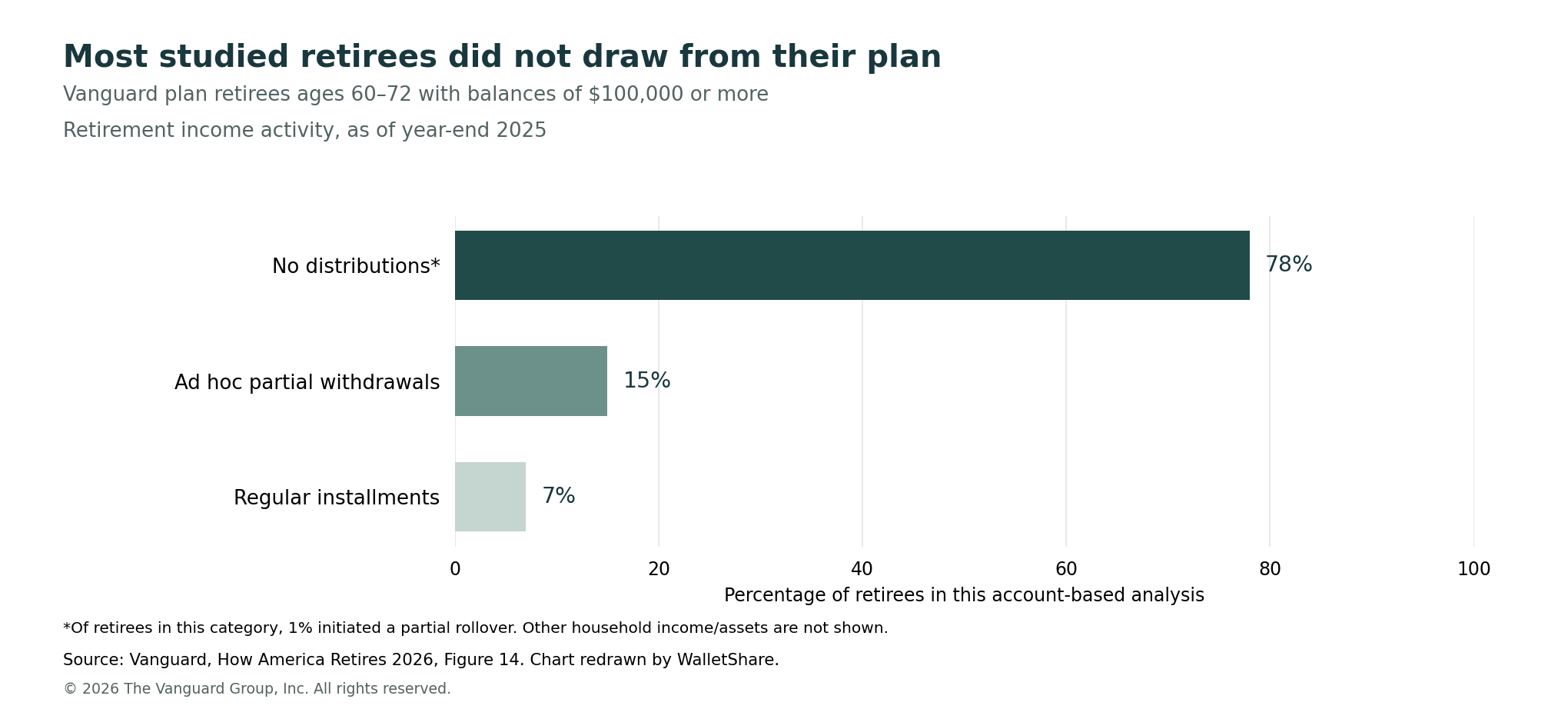
Source: Vanguard, How America Retires 2026, Figure 14. Chart redrawn by WalletShare. These results describe the studied plan accounts, not retirees’ complete household finances.
It would be a mistake to conclude that these retirees had no spending needs or were necessarily reluctant to spend. They could have been using other accounts, a spouse’s earnings, Social Security, pensions, or other resources.
Still, the low use of regular installments highlights how different retirement account ownership can be from having a deliberate retirement paycheck.
Retirement Decisions Unfold Over Time
Keeping money in a former employer’s plan is not always a permanent choice.
Among workers retiring in 2025, 48% remained in their plan at the end of that year, while 31% rolled over their assets. Others cashed out or combined a rollover with a cash distribution.
Looking at an earlier group, Vanguard found that about 65% of 2023 retirees with at least $100,000 had rolled over by the end of 2025, while approximately 30% remained in the plan.
Those findings suggest that the transition may involve a period of adjustment rather than one immediate, final decision.
The report outlines tradeoffs between staying in a plan and moving to an IRA, including fees, investment choices, withdrawal flexibility, oversight, and access to advice. It does not establish that one destination is best for every retiree.
Investment Choices Remain Widely Dispersed
Among the retirees summarized in the report’s investment findings, roughly six in ten held 30% to 80% of their portfolio in stocks. About one-quarter held more than 80% in stocks, while 16% held less than 30%. Rounded figures may not total 100%.
That variation illustrates the range of approaches within retirement. Higher balances were associated with more aggressive allocations, but the data do not establish which allocation was appropriate for each household.
A Starting Point for a Larger Conversation
Vanguard organizes retirement income planning around four principles: start with purpose, strengthen your income, make your wealth last, and simplify.
Together, they shift attention from the size of an account to the life it needs to support.
Future posts will explore several questions raised by the report:
- How longevity and early market losses affect a retirement spending plan.
- Whether to remain in an employer plan or roll savings into an IRA.
- How regular withdrawals compare with flexible spending strategies.
- How Social Security, healthcare expenses, and tax decisions fit together.
- When advice or guaranteed income may help, and what tradeoffs they involve.
Reaching retirement with savings is an important achievement. Converting those savings into a sustainable, workable source of income requires a different set of decisions.
About the research: This is a Vanguard defined contribution plan analysis supplemented by other research, not a nationally representative survey of all retirees. Different findings use different age and account-balance groups. Plan records do not capture every household asset, expense, or income source.
Source: Vanguard, How America Retires 2026. © 2026 The Vanguard Group, Inc. All rights reserved.